Benchmarking Classical & Learning-Based Control on a Real System
Under review for IEEE Robotics & Automation Magazine
Move mouse left/right to control cart · Scroll to zoom · Drag to orbit · Space to reset
Can you keep the ball centered? Move your mouse to control the cart.
13 controllers competed to do this on real hardware: 50 trials each.
A Deceptively Simple Challenge
A nonlinear, underactuated control problem with real-world sensing constraints.

Sensor blind zone: ToF sensors cannot see the ball near the arc edges (|θ| > ~0.071 rad), creating unobservable states at the worst possible moment
Sensor noise: about 13 mm peak-to-peak variation with the ball stationary at center (σ ≈ 3.3 mm on the fused estimate, no filtering applied, ~10-12 Hz update)
Sensor zero-offset: replacing or repositioning ToF sensors introduces a variable offset (±several mm) from true center, silently biasing every controller differently each time
Sim-to-real gap: first-order lag model approximates the PLC's 7-phase motion profile; mismatch in cart acceleration transients couples directly into ball dynamics
Hard track limits: 1.56m track with no room for error; classical controllers need heuristic wall-override gains that introduce oscillations near endpoints
Industrial-Grade Hardware
Industrial servo, low-cost sensors, and rapid-prototyped mechanics : the noise and imprecision controllers actually face in deployment.
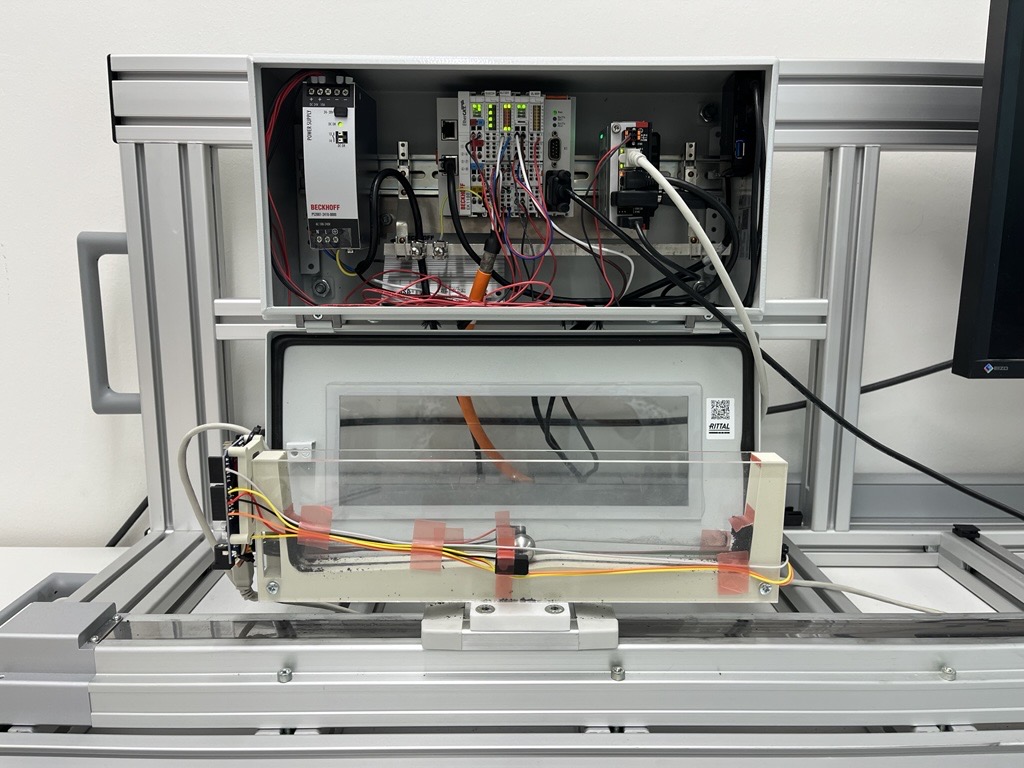
Fig. The ball-on-arc platform.
Why this setup matters: Asynchronous multi-rate sensing, communication latency, and sensor noise create conditions where simulation-optimal controllers can catastrophically fail.
PLC encoder (cart) -> RS232-USB -> Workstation
-> merge as [x, ẋ, θ, θ̇] -> Controller -> USB -> PLC -> Servo
13 Controllers Compared
5 classical + 5 learning-based + 3 data-driven controllers evaluated under identical conditions on real hardware: 50 stratified trials each.
Experimental Results
50 hardware trials per controller at 20 Hz. Difficulty-stratified initial conditions. Identical physical system.
Baseline Performance: 50 Trials per Controller
50 trials, 20 Hz, stratified ICs | Ball settled within ±0.01 rad (±21 mm of arc) for 1 s, 30 s timeout
Both axes increase toward worse outcomes, so the ideal corner is bottom-left. MPPI is the best point estimate on both axes (0% failures, 1.67 s median settling). Two controllers reach 100% success, and no pairwise success-rate difference within the reliable group is statistically significant at 50 trials; MPPI's advantage is confined to settling speed (significantly faster than nine of the twelve others). SMC+WO and LQR+WO coincide exactly (92%, 8.28 s median) and are nudged apart slightly so both stay visible. Hover a point for details.
Data table
| Controller | Family | SR (%) | Median settle (s) | Mean settle (s) |
|---|---|---|---|---|
| MPPI | Real-Data | 100 | 1.67 | 2.06 |
| PPO (BZ+DR) | Sim RL | 96 | 3.15 | 3.81 |
| PD+WO | Classical | 96 | 3.38 | 5.80 |
| PPO (WM) | Real-Data | 100 | 3.64 | 6.84 |
| LQR+WO | Classical | 92 | 8.28 | 10.21 |
| NMPC | Predictive | 90 | 4.71 | 7.48 |
| TRPO (DR) | Sim RL | 90 | 4.80 | 8.09 |
| TQC (DR) | Sim RL | 86 | 6.61 | 9.77 |
| SMC+WO | Classical | 92 | 8.28 | 8.93 |
| SAC (DR) | Sim RL | 82 | 8.40 | 10.10 |
| MPC+WO | Predictive | 80 | 9.65 | 10.81 |
| IQL | Real-Data | 92 | 9.80 | 10.62 |
| TD3 (DR) | Sim RL | 92 | 10.06 | 11.45 |
BZ = Blind Zone sensor modelling, DR = Domain Randomization, WO = Wall Override, WM = World Model (LSTM-based next-state prediction). Data-driven methods (MPPI, PPO WM, IQL) use learned dynamics or logged data (no simulation SR reported).
Settling Time by Starting-Position Stratum
Median time to settle, by cart initial position (50 stratified trials, successful trials only). Bar color encodes the stratum (see legend below); controller category is shown in the first chart.
Hardware median settling time by starting-position stratum. MPPI is fastest and most consistent across all strata (medians 1.3 to 2.2 s). Three equal-width bars per controller: center (left), mid-rail (middle), near-wall (right); the two 5-trial at-wall strata are omitted here (the supplement reports all five). Empty bar = zero successful trials in that stratum. SR = successful trials / total.
Key Takeaways
Add a simple wall-override and almost any controller becomes reliable: PD jumps to 96%, LQR to 92%, SMC to 92% (NMPC handles the boundary on its own, 90%). Once the rail is handled, all four control families tie statistically on reliability. Boundary handling matters more than the classical-versus-learned choice.
One small LSTM, trained on logged hardware data, gives two ways to run the system. MPPI plans with it live: 100% success, fastest settling (1.67 s), lowest effort. PPO-WM instead trains a policy inside a second such model, also 100%, deciding in about 7 ms per step. Both run on CPU, no GPU anywhere.
Domain randomization does most of the sim-to-real work, taking PPO from 60% to 90%, then stops helping. Modelling the sensor blind zone nudges it to 98%, but that gap is too small to call at 50 trials. Agents that balance perfectly in simulation still range 82-96% on hardware, so sim scores do not predict real reliability.
IQL reaches 92% success with almost the lowest control effort, using no simulator at all. It trades speed for simplicity (median 9.8 s). Its training data came free from ordinary evaluation runs, an easy option when you cannot trust a simulator.
Reproduce in Minutes
Fully open-source. Train a PPO policy on CPU, evaluate all controllers in simulation.
# download ball-on-arc.zip (~514 MB) from the anonymized OSF archive:
#   https://osf.io/dxhvp/?view_only=afc8b9f9fed348bf912f4c6bc2bc9fa2
unzip ball-on-arc.zip -d ball-balancing-on-arc
cd ball-balancing-on-arc
make install-full

# Train PPO with blind-zone + domain randomization (about 40 min on CPU)
python training/scripts/train_all_cont.py \
  --algos ppo --rewards balanced --dr --blind-zone \
  --timesteps 3000000 --tag ppo_bz_dr

# Evaluate all controllers in simulation
make eval-sim

# Generate all paper figures
make figuresCite This Work
@article{anon2026ballonarc,
  title   = {A Ball-on-Arc Benchmark: Classical and
             Learning-Based Control on Realistic
             Deployment Hardware},
  journal = {IEEE Robotics \& Automation Magazine},
  year    = {2026},
  note    = {Under review}
}